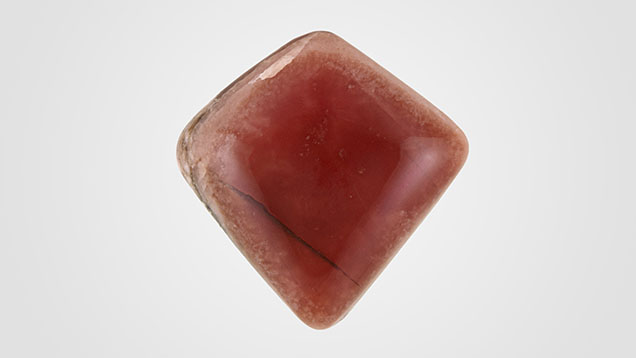
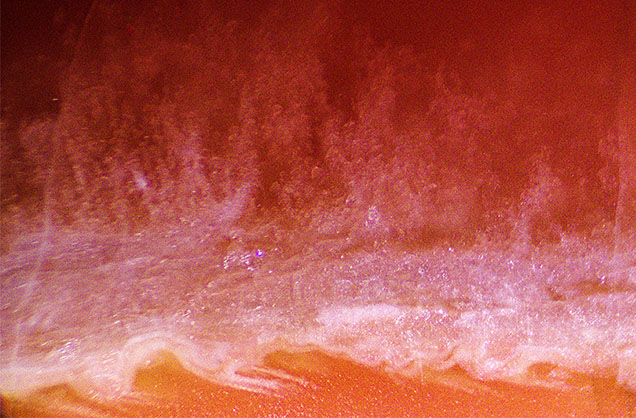
The Carlsbad laboratory recently received an orangy red translucent stone weighing 27.50 ct and measuring approximately 22.46 × 22.11 × 7.42 mm (figure 1). Standard gemological testing revealed a spot refractive index of 1.63 and an absorption band between ~535 and 595 nm with a cutoff of ~480 nm using a handheld spectroscope. The stone contained a long but shallow eye-visible fracture that had been stained black by an unknown substance. A cryptocrystalline aggregate structure was observed under the microscope, with the stone remaining light when rotated in the polariscope. The center of the stone displayed a uniform orangy red color. Small white blebs of carbonate mineralization above a veinlet of white and pink carbonate minerals were found along the perimeter of the stone (figure 2). These observations, along with Raman spectroscopy, were consistent with the rare mineral friedelite (Mn2+8Si6O15(OH,Cl)10).
Friedelite was first discovered in 1876 in the manganese mine at Adervielle, in the Vallée du Luron of the Hautes Pyrenees, France, and named after French chemist and mineralogist Charles Friedel. Since its discovery, friedelite occasionally has been found worldwide in other manganese silicate deposits (H.S. Pienaar, “Gem-quality friedelite from the Kalahari manganese field near Kuruman, South Africa,” Winter 1982 G&G, pp. 221–224). This is the second friedelite GIA has examined to date.
Michaela Damba is a senior staff gemologist at GIA in Carlsbad, California.
The Carlsbad laboratory recently received an orangy red translucent stone weighing 27.50 ct and measuring approximately 22.46 × 22.11 × 7.42 mm (figure 1). Standard gemological testing revealed a spot refractive index of 1.63 and an absorption band between ~535 and 595 nm with a cutoff of ~480 nm using a handheld spectroscope. The stone contained a long but shallow eye-visible fracture that had been stained black by an unknown substance. A cryptocrystalline aggregate structure was observed under the microscope, with the stone remaining light when rotated in the polariscope. The center of the stone displayed a uniform orangy red color. Small white blebs of carbonate mineralization above a veinlet of white and pink carbonate minerals were found along the perimeter of the stone (figure 2). These observations, along with Raman spectroscopy, were consistent with the rare mineral friedelite (Mn2+8Si6O15(OH,Cl)10).
Friedelite was first discovered in 1876 in the manganese mine at Adervielle, in the Vallée du Luron of the Hautes Pyrenees, France, and named after French chemist and mineralogist Charles Friedel. Since its discovery, friedelite occasionally has been found worldwide in other manganese silicate deposits (H.S. Pienaar, “Gem-quality friedelite from the Kalahari manganese field near Kuruman, South Africa,” Winter 1982 G&G, pp. 221–224). This is the second friedelite GIA has examined to date.
Michaela Damba is a senior staff gemologist at GIA in Carlsbad, California.
.jpg "YMAL GIA Ed")