
Treated-Color Pink-To-Red Diamonds from Lucent Diamonds Inc.
Using a multi-step process, Lucent Diamonds has developed a new treatment process for certain natural diamonds that creates colors from pink-purple through red to orangy brown.
A Gemological Study of a Collection of Chameleon Diamonds
Chameleon diamonds are among the rarest of gem diamonds.
高压高温 (HPHT) 生长之合成钻石的特征更新图表 (英语)
A new chart, supplementing the one published in the Winter 1995 issue of Gems & Gemology, summarizes the features of both as-grown (“non-modified”) and treated (“modified”) synthetic diamonds currently in the gem market (that is, those grown by the high pressure/high temperature technique).
The Creation of a Magnificent Suite of Peridot Jewelry: From the Himalayas to Fifth Avenue
Peridot: The ultimate value of a gemstone suite lies not only in the cost and quality of the materials themselves, but also in the selection of the rough, the quality of the faceting, and the intricacy of the setting in a well-designed and well-manufactured suite of jewelry.
亚利桑那州四峰的紫水晶 (英语)
For more than a century, the Four Peaks mine in Maricopa County, Arizona, has produced gem-quality amethyst from crystal-lined or crystal-filled cavities and fractures in a brecciated quartzite host rock.
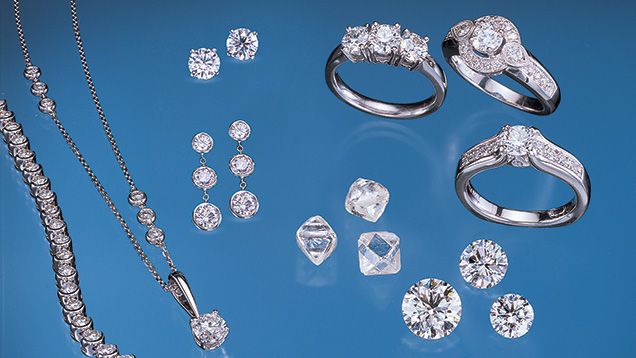
圆形明亮式切工钻石整体切磨品质的分级基础 (英语)
The GIA diamond cut grading system described here includes the components of brightness, fire, scintillation, polish, and symmetry, as well as weight and durability concerns, into a single overall grade for cut quality for standard round brilliants.
宝石处理公开及美国 法律 (英语)
In recent years, the obligation to fully disclose all gem treatments has changed from a mere ethical responsibility to a legal one.
Chatham Created Gems 的实验室合成彩钻 (英语)
This article compares some of Chatham Created Gems’ synthetic colored diamonds to natural diamonds and explains the results.
Spring 2004 Gem News International
Cultured Pearls from the Gulf of California, Mexico
This article provides an overview of the history of natural and cultured pearls from Mexico, describes pearl culturing at the Guaymas farm, and focuses on the properties of bead-nucleated cultured pearls from P. sterna.
Identification of Synthetic Diamond Grown Using Chemical Vapor Deposition (CVD)
This article presents information about the CVD process, the history of its development, and properties that differentiate the resulting synthetic crystals from natural diamond.
Pezzottaite from Ambatovita, Madagascar: A New Gem Mineral
Pezzottaite, ideally Cs(Be2Li)Al2Si6O18, is a new gem mineral that is the Cs,Li–rich member of the beryl group.
Gem-Quality Synthetic Diamonds Grown by a Chemical Vapor Deposition (CVD) Method
Brown-to-gray and near-colorless single-crystal type IIa synthetic diamonds grown using a chemical vapor deposition (CVD) technique by Apollo Diamond Inc. have gemological properties that are distinct from those of both natural diamonds and HPHT-grown synthetic gem diamonds.
Red Beryl from Utah: A Review and Update
There is only one known commercial occurrence of gem-quality red beryl in the world: the Ruby Violet (or Red Beryl) mine in the Wah Wah Mountains of Beaver County, Utah.
An Investigation into the Cause of Color in Natural Black Diamonds from Siberia
Black and dark gray diamonds from Siberia, Russia, were studied by analytical scanning and transmission electron microscopy.
An Important Exhibition of Seven Rare Gem Diamonds
The stories behind seven strikingly beautiful rare natural diamonds, united in an exhibit at the Smithsonian, are told here.
Beryllium Diffusion of Ruby and Sapphire
The heat treatment of corundum involving lattice diffusion of beryllium (Be) at temperatures over 1800°C has become a major issue in the gem trade.
Poudretteite: A Rare Gem Species from the Mogok Valley
The rare borosilicate poudretteite, a mineral that previously had been identified only as tiny crystals.
The First Transparent Faceted Grandidierite, from Sri Lanka
Gemological, chemical, and spectroscopic properties are presented for the first known transparent faceted grandidierite.
宝石学家显微摄影 (英语)
Just because you don’t see it, doesn’t mean it isn’t there.
Many areas in the jewelry industry—education, gemological research, lecturing, publication, and laboratory and inventory documentation, to name a few—either require or benefit from high-quality photomicrography.
.jpg "YMAL GIA Ed")