
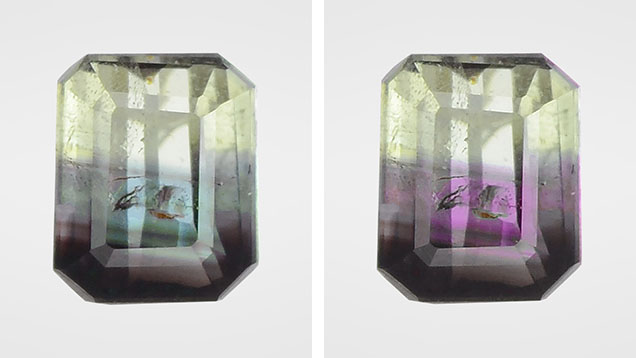
Recently, the Tokyo laboratory received for identification service a bicolor 0.73 ct octagonal step cut measuring 5.33 × 4.37 × 2.74 mm. One zone was greenish yellow, and the other was blue-green in fluorescent light and red-purple in incandescent light (figure 1).
Standard gemological testing results, including a refractive index of 1.747 to 1.753, and Raman spectroscopy proved that this stone was zoned chrysoberyl, and more notably an extremely rare zoned chrysoberyl and alexandrite gem. Microscopic examination revealed the presence of fingerprints, straight graining, and two-phase fluid inclusions (figure 2). No evidence of coating or clarity enhancement was observed. This is the first time GIA has documented a stone composed of chrysoberyl and alexandrite.
Recently, the Tokyo laboratory received for identification service a bicolor 0.73 ct octagonal step cut measuring 5.33 × 4.37 × 2.74 mm. One zone was greenish yellow, and the other was blue-green in fluorescent light and red-purple in incandescent light (figure 1).
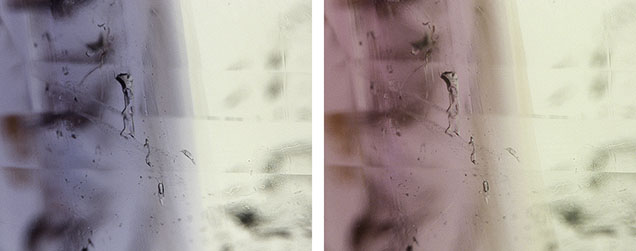
Standard gemological testing results, including a refractive index of 1.747 to 1.753, and Raman spectroscopy proved that this stone was zoned chrysoberyl, and more notably an extremely rare zoned chrysoberyl and alexandrite gem. Microscopic examination revealed the presence of fingerprints, straight graining, and two-phase fluid inclusions (figure 2). No evidence of coating or clarity enhancement was observed. This is the first time GIA has documented a stone composed of chrysoberyl and alexandrite.