
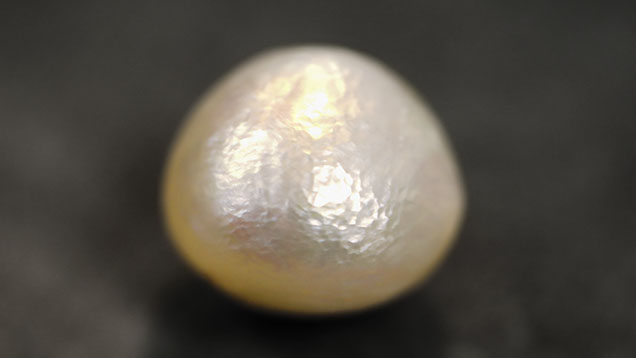
The authors recently examined a white button-shaped pearl weighing 9.92 ct and measuring 11.76 × 11.20 × 10.62 mm (figure 1), which was identified as a natural pearl formed in a saltwater environment. One intriguing feature of the pearl was a distinctive pattern resembling the hammered surface commonly seen on brass and copper ornaments. The pearl’s surface appeared to show a series of closely packed shallow indentations on the nacre surface, forming ridges in a mosaic pattern (P. Southgate and J. Lucas, The Pearl Oyster, 2008, p. 296).
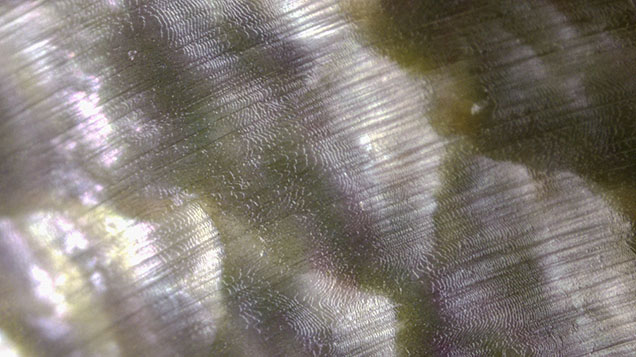
Microscopic examination revealed that the hammered effect was subsurface and did not actually result in any exterior indentations. However, the pearl’s surface was covered in shallow worked lines, crisscrossing in angular directions with an attempt to create a smoother surface without any irregularities (figure 2).
The surface nacre layer of the pearl was translucent, making it easier to observe the pattern in the underlying nacre layers along with the strong orient caused by these subsurface indentations. Due to the worked surface of the pearl, the interaction of light with these layers created an optical illusion of a bumpy texture when viewed without magnification.
While the authors have previously encountered pearls with a subsurface hammered appearance, this effect combined with extensive working was notable.
The authors recently examined a white button-shaped pearl weighing 9.92 ct and measuring 11.76 × 11.20 × 10.62 mm (figure 1), which was identified as a natural pearl formed in a saltwater environment. One intriguing feature of the pearl was a distinctive pattern resembling the hammered surface commonly seen on brass and copper ornaments. The pearl’s surface appeared to show a series of closely packed shallow indentations on the nacre surface, forming ridges in a mosaic pattern (P. Southgate and J. Lucas, The Pearl Oyster, 2008, p. 296).
Microscopic examination revealed that the hammered effect was subsurface and did not actually result in any exterior indentations. However, the pearl’s surface was covered in shallow worked lines, crisscrossing in angular directions with an attempt to create a smoother surface without any irregularities (figure 2).
The surface nacre layer of the pearl was translucent, making it easier to observe the pattern in the underlying nacre layers along with the strong orient caused by these subsurface indentations. Due to the worked surface of the pearl, the interaction of light with these layers created an optical illusion of a bumpy texture when viewed without magnification.
While the authors have previously encountered pearls with a subsurface hammered appearance, this effect combined with extensive working was notable.