
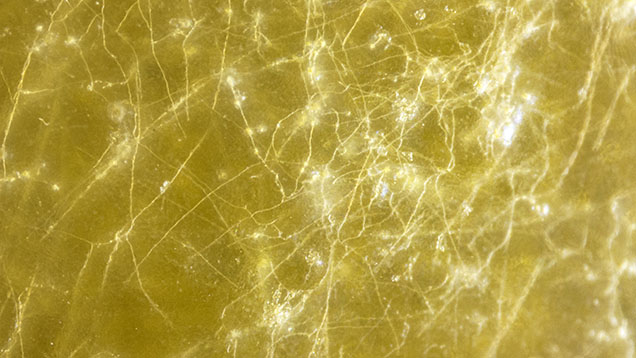
Recently, the authors examined an intriguing white button-shaped assembled cultured shell blister, commonly referred to in the trade as a mabe pearl. This mabe pearl, which measured approximately 15.31 × 15.10 mm and was mounted in an earring, exhibited a semitranslucent surface with iridescence. When examined under higher magnification with fiber-optic illumination, an intricate network of fine branch-like structures was observed just beneath the nacreous surface. Closer examination revealed channels resembling a mass of fungal hyphae, the microscopic thread-like filaments found in fungi and molds (see above). These channels were likely formed by shell-boring parasites; parasitic worms often infest pearl-producing mollusks, resulting in the formation of elongated channels with varying patterns. Although parasitic boreholes have been previously documented in both shells and pearls (Spring 2024 G&G Micro-World, p. 78), this unique arrangement of intersecting tunnels displays a striking resemblance to the microscopic morphology of fungal hyphae, highlighting the complex biological interactions that can influence nacre formation.
Gauri Sarvankar is a senior staff gemologist at GIA in Mumbai. Abeer Al-Alawi is a consultant to GIA.
Recently, the authors examined an intriguing white button-shaped assembled cultured shell blister, commonly referred to in the trade as a mabe pearl. This mabe pearl, which measured approximately 15.31 × 15.10 mm and was mounted in an earring, exhibited a semitranslucent surface with iridescence. When examined under higher magnification with fiber-optic illumination, an intricate network of fine branch-like structures was observed just beneath the nacreous surface. Closer examination revealed channels resembling a mass of fungal hyphae, the microscopic thread-like filaments found in fungi and molds (see above). These channels were likely formed by shell-boring parasites; parasitic worms often infest pearl-producing mollusks, resulting in the formation of elongated channels with varying patterns. Although parasitic boreholes have been previously documented in both shells and pearls (Spring 2024 G&G Micro-World, p. 78), this unique arrangement of intersecting tunnels displays a striking resemblance to the microscopic morphology of fungal hyphae, highlighting the complex biological interactions that can influence nacre formation.
Gauri Sarvankar is a senior staff gemologist at GIA in Mumbai. Abeer Al-Alawi is a consultant to GIA.