
Recognizable mineral inclusions in diamond are rather unusual. The most common inclusion in gem-quality diamond is often referred to as a “carbon spot,” which is a collective term used to describe any dark inclusion in diamond. The most prominent dark mineral inclusions in diamond, carbon spots are typically chromite, graphite, or sulfides. Of the three, only graphite is composed of carbon. Sulfides are fairly common as inclusions, and chromite crystals are the only type of carbon spot that is actually rare.
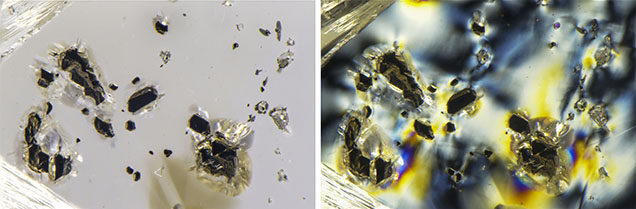
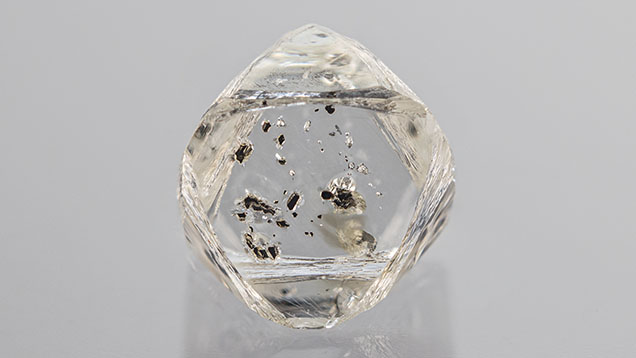
This quarter’s subject is a transparent, colorless, and partially etched diamond octahedron, which came from Sierra Leone, by way of David New in Tucson, Arizona. The diamond crystal, weighing 1.17 ct and measuring 6.61 × 5.94 × 3.09 mm, hosts numerous opaque black solids situated along octahedral planes (figure 1). Laser Raman microspectrometry identified one of the included crystals as chromite. As an inclusion in diamond, chromite is generally opaque and black with a submetallic to vitreous luster and typically forms as angular mineral grains (figure 2, top). In polarized light, the chromite inclusions are observed to cause strain in the diamond host (figure 2, bottom).
John Koivula is analytical microscopist, and Nathan Renfro is senior manager of colored stone identification, at GIA in Carlsbad, California.
Recognizable mineral inclusions in diamond are rather unusual. The most common inclusion in gem-quality diamond is often referred to as a “carbon spot,” which is a collective term used to describe any dark inclusion in diamond. The most prominent dark mineral inclusions in diamond, carbon spots are typically chromite, graphite, or sulfides. Of the three, only graphite is composed of carbon. Sulfides are fairly common as inclusions, and chromite crystals are the only type of carbon spot that is actually rare.
This quarter’s subject is a transparent, colorless, and partially etched diamond octahedron, which came from Sierra Leone, by way of David New in Tucson, Arizona. The diamond crystal, weighing 1.17 ct and measuring 6.61 × 5.94 × 3.09 mm, hosts numerous opaque black solids situated along octahedral planes (figure 1). Laser Raman microspectrometry identified one of the included crystals as chromite. As an inclusion in diamond, chromite is generally opaque and black with a submetallic to vitreous luster and typically forms as angular mineral grains (figure 2, top). In polarized light, the chromite inclusions are observed to cause strain in the diamond host (figure 2, bottom).
John Koivula is analytical microscopist, and Nathan Renfro is senior manager of colored stone identification, at GIA in Carlsbad, California.