
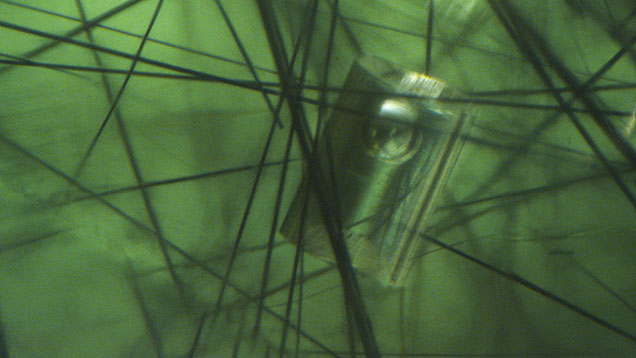
Pakistani peridot is known for its diagnostic ludwigite inclusions, but something far rarer was recently observed in a 7.44 ct faceted stone—a fluid-filled cylindrical void among a myriad of needle-like ludwigite crystals (see above). The void also contained a spherical gas bubble that shifted within the liquid as the stone was moved. This feature is known as a two-phase inclusion due to the negative space containing a liquid and a gas. Cylindrical-shaped inclusions are uncommon in any stone, as cylinders do not conform to any crystallographic habit; however, a similar example has been documented in a pink euclase crystal (Fall 2021 G&G Micro-World, pp. 274—275).
Britni LeCroy is a senior staff gemologist at GIA in Carlsbad, California.
Pakistani peridot is known for its diagnostic ludwigite inclusions, but something far rarer was recently observed in a 7.44 ct faceted stone—a fluid-filled cylindrical void among a myriad of needle-like ludwigite crystals (see above). The void also contained a spherical gas bubble that shifted within the liquid as the stone was moved. This feature is known as a two-phase inclusion due to the negative space containing a liquid and a gas. Cylindrical-shaped inclusions are uncommon in any stone, as cylinders do not conform to any crystallographic habit; however, a similar example has been documented in a pink euclase crystal (Fall 2021 G&G Micro-World, pp. 274—275).
Britni LeCroy is a senior staff gemologist at GIA in Carlsbad, California.