
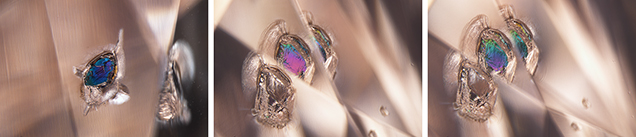
Most diamonds originate from the cratonic lithosphere, the basal portion of the thickest, oldest parts of continents. Rarely, diamonds are found with mineral inclusions that indicate a deeper origin, below the lithosphere, within the convecting mantle. Ferropericlase, (Mg,Fe)O, is one of the most common of such “superdeep” inclusion phases (T. Stachel et al., “Inclusions in sublithospheric diamonds: Glimpses of deep Earth,” Elements, Vol. 1, 2005, pp. 73–78). It often exhibits a vivid iridescence that serves as a helpful identifier. A 1.54 ct Fancy Light pink type IIa diamond with a spectacular ferropericlase inclusion was recently examined in GIA’s New York lab (see above). The exact cause of this iridescence is unknown, but it may arise at the inclusion-diamond interface due to thin-film interference from trapped fluid or structural coloration from ultra-fine exsolution of magnesioferrite. The iridescent colors of these ferropericlase inclusions change with viewing and lighting angles. The iridescence is not always uniform and can sometimes be absent, in which case the inclusion appears a transparent deep brown color.
Strictly speaking, ferropericlase inclusions alone do not necessarily indicate a sublithospheric origin (T. Stachel et al., 2005). This is the case for the present diamond, so the assignment of sublithospheric origin is only tentative. It may be possible to create ferropericlase at shallower depths, in the lithosphere, if special conditions occur that lower the availability of silica.
Most diamonds originate from the cratonic lithosphere, the basal portion of the thickest, oldest parts of continents. Rarely, diamonds are found with mineral inclusions that indicate a deeper origin, below the lithosphere, within the convecting mantle. Ferropericlase, (Mg,Fe)O, is one of the most common of such “superdeep” inclusion phases (T. Stachel et al., “Inclusions in sublithospheric diamonds: Glimpses of deep Earth,” Elements, Vol. 1, 2005, pp. 73–78). It often exhibits a vivid iridescence that serves as a helpful identifier. A 1.54 ct Fancy Light pink type IIa diamond with a spectacular ferropericlase inclusion was recently examined in GIA’s New York lab (see above). The exact cause of this iridescence is unknown, but it may arise at the inclusion-diamond interface due to thin-film interference from trapped fluid or structural coloration from ultra-fine exsolution of magnesioferrite. The iridescent colors of these ferropericlase inclusions change with viewing and lighting angles. The iridescence is not always uniform and can sometimes be absent, in which case the inclusion appears a transparent deep brown color.
Strictly speaking, ferropericlase inclusions alone do not necessarily indicate a sublithospheric origin (T. Stachel et al., 2005). This is the case for the present diamond, so the assignment of sublithospheric origin is only tentative. It may be possible to create ferropericlase at shallower depths, in the lithosphere, if special conditions occur that lower the availability of silica.