
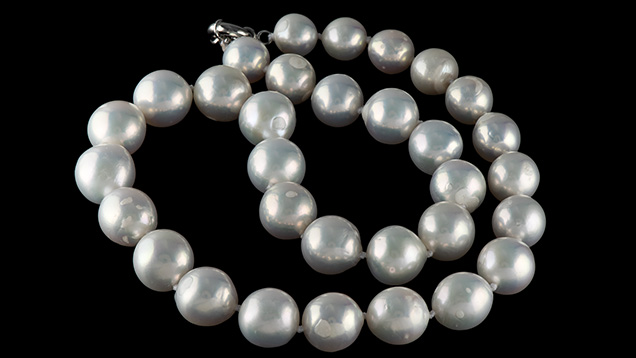
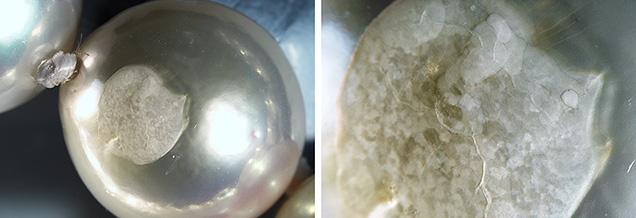
Recently, GIA’s New York laboratory received a single-strand necklace with 32 pearls for identification (figure 1). The pearls were white and near-round, ranging from 10.33 × 10.18 mm to 13.36 × 12.72 mm in size and weighing 81.50 grams total. Real-time microradiography (RTX) analysis revealed that all of them had a bead nucleus. Chemical analysis by EDXRF spectrometry showed a high manganese concentration and low strontium, indicating they formed in a freshwater environment. During examination of the strand, random white patches were observed on the surface of many of the pearls. These irregular patches appeared overgrown on the surface and crystalline-like (figure 2).
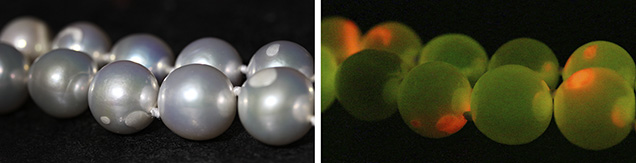
X-ray fluorescence analysis revealed a strong yellowish green reaction around each pearl, while the irregular white surface patches showed a reddish orange reaction with moderate intensity (figure 3).
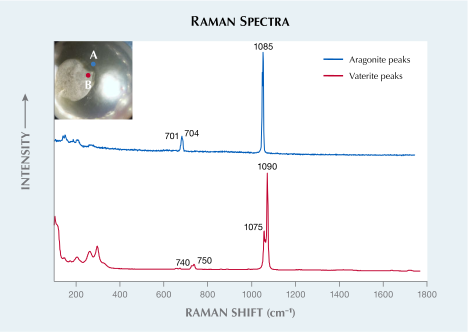
Additionally, Raman analysis of the nacreous surface and the irregular white patches revealed they consisted of two calcium carbonate polymorphs: aragonite and vaterite, respectively (figure 4). Aragonite peaks were observed at 701, 704, and 1085 cm–1; vaterite peaks were at 740, 750, 1075, and 1090 cm–1.
Formation of the shells and pearls relies on the epithelial cells of the mollusk. Aragonite and calcite are the two most common calcium carbonate polymorphs found in pearls, while vaterite is the third most common and also the least stable form. Vaterite has only been found in freshwater pearls so far (Li Qiao et al., “Special vaterite found in freshwater lackluster pearls,” Crystal Growth & Design, Vol. 7, No. 2, 2007, pp. 275–279; Summer 2021 Gem News International, pp. 171–174). Although the reason why vaterite formed on the pearls’ surface is unknown, the defect is one of the most unusual formations seen, especially in an entire strand.
Recently, GIA’s New York laboratory received a single-strand necklace with 32 pearls for identification (figure 1). The pearls were white and near-round, ranging from 10.33 × 10.18 mm to 13.36 × 12.72 mm in size and weighing 81.50 grams total. Real-time microradiography (RTX) analysis revealed that all of them had a bead nucleus. Chemical analysis by EDXRF spectrometry showed a high manganese concentration and low strontium, indicating they formed in a freshwater environment. During examination of the strand, random white patches were observed on the surface of many of the pearls. These irregular patches appeared overgrown on the surface and crystalline-like (figure 2).
X-ray fluorescence analysis revealed a strong yellowish green reaction around each pearl, while the irregular white surface patches showed a reddish orange reaction with moderate intensity (figure 3).
Additionally, Raman analysis of the nacreous surface and the irregular white patches revealed they consisted of two calcium carbonate polymorphs: aragonite and vaterite, respectively (figure 4). Aragonite peaks were observed at 701, 704, and 1085 cm–1; vaterite peaks were at 740, 750, 1075, and 1090 cm–1.
Formation of the shells and pearls relies on the epithelial cells of the mollusk. Aragonite and calcite are the two most common calcium carbonate polymorphs found in pearls, while vaterite is the third most common and also the least stable form. Vaterite has only been found in freshwater pearls so far (Li Qiao et al., “Special vaterite found in freshwater lackluster pearls,” Crystal Growth & Design, Vol. 7, No. 2, 2007, pp. 275–279; Summer 2021 Gem News International, pp. 171–174). Although the reason why vaterite formed on the pearls’ surface is unknown, the defect is one of the most unusual formations seen, especially in an entire strand.