Chemical vapor deposition (CVD) diamond growth has greatly improved over the years. More CVD-grown diamonds are seen in the market today, and in recent years, larger CVD-grown diamonds are beginning to emerge. In 2016, the GIA laboratory in Hong Kong examined a 5.19 ct cushion, the largest CVD-grown diamond analyzed at GIA until now (Winter 2016 Lab Notes, pp. 414–416).
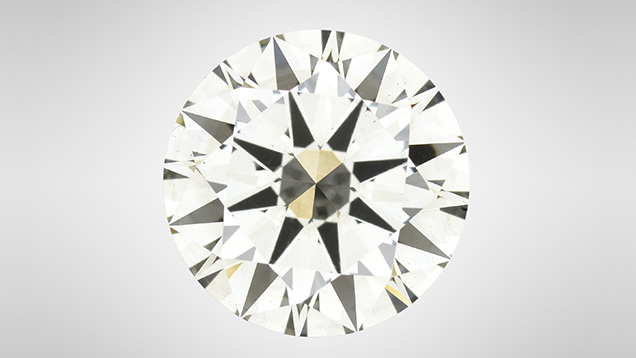
A larger CVD-grown diamond was recently submitted to the GIA laboratory in Carlsbad: a round brilliant with VS2 clarity and M color weighing just over 7 carats (figure 1). This 7.07 ct CVD-grown diamond came to the Carlsbad laboratory undisclosed as CVD, but advanced testing correctly identified this diamond’s origin. The largest reported faceted CVD-grown diamond is a 12.75 ct round brilliant (“IGI’s Hong Kong lab certifies largest CVD grown diamond,” IGI Press Room, November 23, 2020).
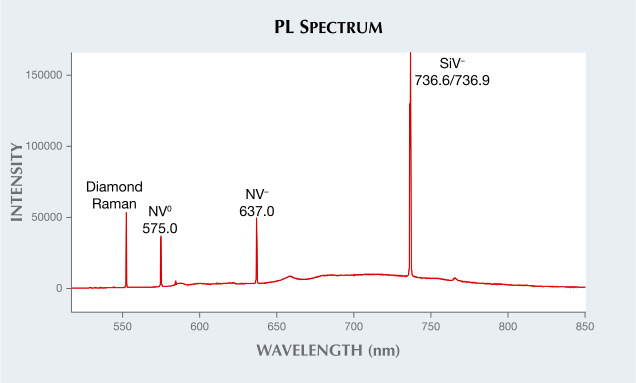
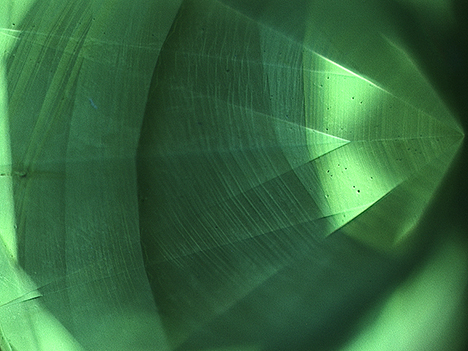
Microscopic investigation revealed grade setting graphitic inclusions just below the center of the table. Photoluminescence investigation showed characteristic growth features consistent with a CVD-grown diamond that was subsequently HPHT-treated, generally intended to reduce the brown coloration. With 514 nm excitation at liquid nitrogen temperature (–196°C), nitrogen-vacancy centers at 575 [NV]0 and 637 [NV]– nm, along with a strong [SiV]– doublet at 736.6/736.9 nm were revealed (figure 2) determining this diamond as CVD-grown. When viewed through the DiamondView, growth layers were evident (figure 3), and the green fluorescence along with the lack of a 596/597 nm feature in the PL spectrum were indicative of post-growth HPHT treatment (figure 3; Wang et al., “CVD synthetic diamonds from Gemesis Corp.,” Summer 2012 G&G, pp. 80–97).
CVD-grown diamonds of these sizes are still a rarity, but with new technologies and advancements it is evident that larger laboratory-grown diamonds are becoming more prevalent.
Garrett McElhenny is a research technician, and Sally Eaton-Magaña is senior manager of diamond identification, at GIA in Carlsbad, California.
Chemical vapor deposition (CVD) diamond growth has greatly improved over the years. More CVD-grown diamonds are seen in the market today, and in recent years, larger CVD-grown diamonds are beginning to emerge. In 2016, the GIA laboratory in Hong Kong examined a 5.19 ct cushion, the largest CVD-grown diamond analyzed at GIA until now (Winter 2016 Lab Notes, pp. 414–416).
A larger CVD-grown diamond was recently submitted to the GIA laboratory in Carlsbad: a round brilliant with VS2 clarity and M color weighing just over 7 carats (figure 1). This 7.07 ct CVD-grown diamond came to the Carlsbad laboratory undisclosed as CVD, but advanced testing correctly identified this diamond’s origin. The largest reported faceted CVD-grown diamond is a 12.75 ct round brilliant (“IGI’s Hong Kong lab certifies largest CVD grown diamond,” IGI Press Room, November 23, 2020).
Microscopic investigation revealed grade setting graphitic inclusions just below the center of the table. Photoluminescence investigation showed characteristic growth features consistent with a CVD-grown diamond that was subsequently HPHT-treated, generally intended to reduce the brown coloration. With 514 nm excitation at liquid nitrogen temperature (–196°C), nitrogen-vacancy centers at 575 [NV]0 and 637 [NV]– nm, along with a strong [SiV]– doublet at 736.6/736.9 nm were revealed (figure 2) determining this diamond as CVD-grown. When viewed through the DiamondView, growth layers were evident (figure 3), and the green fluorescence along with the lack of a 596/597 nm feature in the PL spectrum were indicative of post-growth HPHT treatment (figure 3; Wang et al., “CVD synthetic diamonds from Gemesis Corp.,” Summer 2012 G&G, pp. 80–97).
CVD-grown diamonds of these sizes are still a rarity, but with new technologies and advancements it is evident that larger laboratory-grown diamonds are becoming more prevalent.
Garrett McElhenny is a research technician, and Sally Eaton-Magaña is senior manager of diamond identification, at GIA in Carlsbad, California.
.jpg "YMAL GIA Ed")