
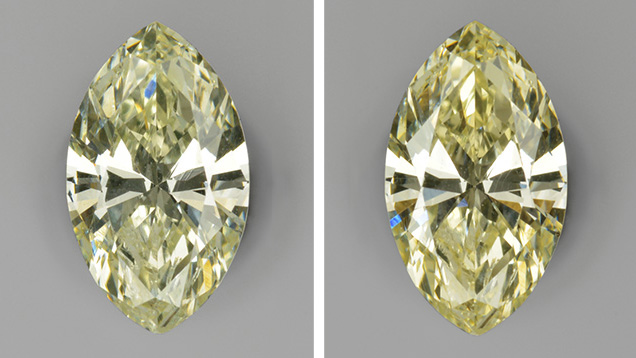
The Carlsbad laboratory recently examined a 0.31 ct Light greenish yellow marquise-cut diamond. The stone displayed the strong yellow fluorescence, persistent yellow phosphorescence, and green color component of a chameleon diamond. A chameleon diamond has a green or greenish color component under normal conditions. When heated or left in the dark for long periods of time, the green component temporarily disappears, giving way to an orange component. Figure 1 shows the diamond before and immediately after heating, in which the removal of the green component leads to an orange-dominant hue, demonstrating that the stone was in fact a chameleon diamond. Unfortunately, the stone’s low saturation makes the effect less noticeable.
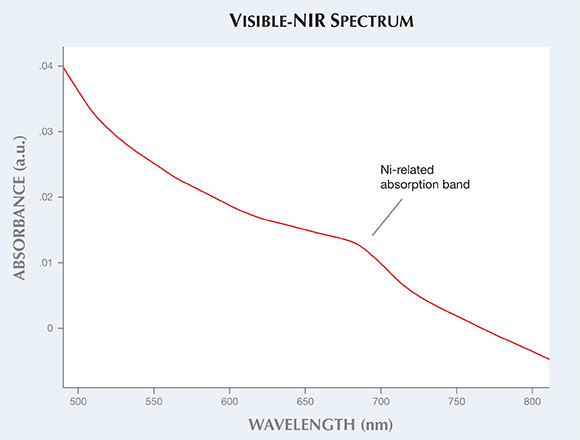
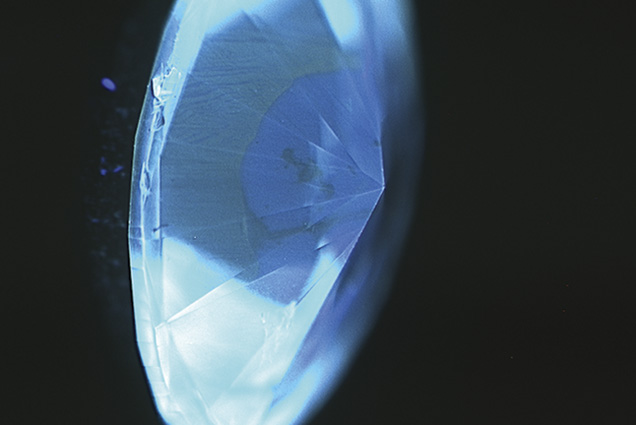
Examination of the visible-NIR spectrum revealed a noticeable nickel-related absorption band at 685 nm (figure 2). DiamondView images were taken to prove the stone was not synthetic, as nickel is a common catalyst in HPHT synthetics (figure 3). While nickel has long been known to occur as a trace element in chameleon diamonds (T. Hainschwang et al., “A gemological study of a collection of chameleon diamonds,” Spring 2005 G&G; , pp. 20–34), its role in the color-change effect is unknown. Nickel has also been reported as a cause of green coloration in certain diamonds (W. Wang et al., “Natural type Ia diamond with green-yellow color due to Ni-related defects,” Fall 2007 G&G; , pp. 240–243), but this may be the first time it has been identified as the major cause of a green component in a chameleon. The rarity of chameleon diamond, combined with the rarity of Ni-related natural green diamonds, makes this a truly unique specimen.
The Carlsbad laboratory recently examined a 0.31 ct Light greenish yellow marquise-cut diamond. The stone displayed the strong yellow fluorescence, persistent yellow phosphorescence, and green color component of a chameleon diamond. A chameleon diamond has a green or greenish color component under normal conditions. When heated or left in the dark for long periods of time, the green component temporarily disappears, giving way to an orange component. Figure 1 shows the diamond before and immediately after heating, in which the removal of the green component leads to an orange-dominant hue, demonstrating that the stone was in fact a chameleon diamond. Unfortunately, the stone’s low saturation makes the effect less noticeable.
Examination of the visible-NIR spectrum revealed a noticeable nickel-related absorption band at 685 nm (figure 2). DiamondView images were taken to prove the stone was not synthetic, as nickel is a common catalyst in HPHT synthetics (figure 3). While nickel has long been known to occur as a trace element in chameleon diamonds (T. Hainschwang et al., “A gemological study of a collection of chameleon diamonds,” Spring 2005 G&G; , pp. 20–34), its role in the color-change effect is unknown. Nickel has also been reported as a cause of green coloration in certain diamonds (W. Wang et al., “Natural type Ia diamond with green-yellow color due to Ni-related defects,” Fall 2007 G&G; , pp. 240–243), but this may be the first time it has been identified as the major cause of a green component in a chameleon. The rarity of chameleon diamond, combined with the rarity of Ni-related natural green diamonds, makes this a truly unique specimen.