
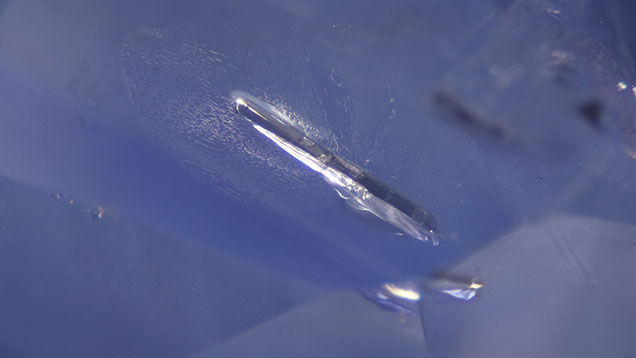
The author recently examined a sapphire containing an elongated, rod-shaped crystal associated with a partially healed fissure (see above). Due to its morphology and color, the inclusion appeared to be pargasite. However, subsequent analysis using Raman spectroscopy identified the inclusion as vesuvianite.
Vesuvianite is an accessory sorosilicate mineral that typically forms in skarn during metasomatism of carbonate rocks such as limestone. Exceptionally rare as an inclusion in gemstones, vesuvianite has previously only been documented in two rubies from Mogok, Myanmar (Winter 2017 G&G Micro-World, p. 469; C.P. Smith and R. Zellagui, “Vesuvianite (idocrase) and apatite inclusions in ruby identifiable by infrared spectroscopy,” Journal of Gemmology, Vol. 37, No. 4, 2020, pp. 346–348). Given the association of vesuvianite with skarns, these inclusions may also occur in sapphires from skarn deposits, such as those in Andranondambo, Madagascar, and Kataragama and Elahera, Sri Lanka (G. Giuliani and L.A. Groat, “Geology of corundum and emerald gem deposits: A review,” Winter 2019 G&G, pp. 464–489).
To the author’s knowledge, this is the first report of vesuvianite as an inclusion in sapphire.
Sharon Tao is a senior gemologist at the Gübelin Gem Lab in Lucerne, Switzerland.
The author recently examined a sapphire containing an elongated, rod-shaped crystal associated with a partially healed fissure (see above). Due to its morphology and color, the inclusion appeared to be pargasite. However, subsequent analysis using Raman spectroscopy identified the inclusion as vesuvianite.
Vesuvianite is an accessory sorosilicate mineral that typically forms in skarn during metasomatism of carbonate rocks such as limestone. Exceptionally rare as an inclusion in gemstones, vesuvianite has previously only been documented in two rubies from Mogok, Myanmar (Winter 2017 G&G Micro-World, p. 469; C.P. Smith and R. Zellagui, “Vesuvianite (idocrase) and apatite inclusions in ruby identifiable by infrared spectroscopy,” Journal of Gemmology, Vol. 37, No. 4, 2020, pp. 346–348). Given the association of vesuvianite with skarns, these inclusions may also occur in sapphires from skarn deposits, such as those in Andranondambo, Madagascar, and Kataragama and Elahera, Sri Lanka (G. Giuliani and L.A. Groat, “Geology of corundum and emerald gem deposits: A review,” Winter 2019 G&G, pp. 464–489).
To the author’s knowledge, this is the first report of vesuvianite as an inclusion in sapphire.
Sharon Tao is a senior gemologist at the Gübelin Gem Lab in Lucerne, Switzerland.