
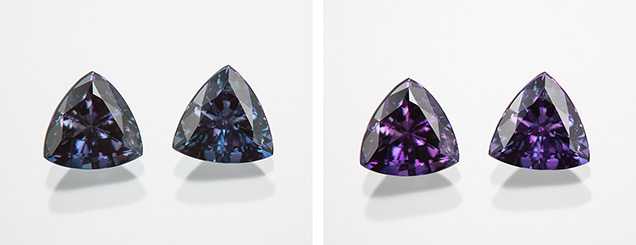
Gil International’s booth at the AGTA show featured something out of the ordinary: a display case with lighting selected to reveal the color change of their Brazilian alexandrites, from blue-green in daylight to reddish purple in incandescent light. Goel “Gil” Gul built the case himself, and he said it has drawn traffic to the booth over the years. Based in New York, Gil International began exhibiting in Tucson 30 years ago; 2019 was their 19th year at the AGTA show.
Gil International specializes in natural Brazilian alexandrite (see above), which exhibits a strong color change. Alexandrite was first found in Russia’s Ural Mountains in the 1830s. It wasn’t until the discovery of Brazilian sources in the late 1980s, most notably Lavra de Hematita (also called Nova Era or Itabira), that greater quantities became available, though alexandrite is still considered rare.
Alexandrite has been in greater demand over the last 15 years, Gul said, but business has been slow the last two. In the past decade, his sales to a company that caters to cruise ships have been particularly strong. He attributes this to people “always looking for something unusual” and having more time to look at jewelry while on vacation. When Gul entered the industry, aquamarine, tourmaline, and zircon were big. Sapphire has always been very strong, he said, but ruby has come down in the last five years. The demand for stones rises and falls over the decades based on jewelry house promotion, he said, citing Tiffany & Co.’s marketing campaign after the discovery of tanzanite in 1967. He added that more people are buying brown diamonds, previously considered undesirable, because of Le Vian’s branding and heavy advertising of “chocolate diamonds.”

- Copyrights and Trademarks
- Privacy Notice
- Terms of Use
- Cookie Notice
- Ethics and Compliance
- Transparency in Coverage Rule
- About This Site
© 2002 -
Loading video player...
Gil International’s booth at the AGTA show featured something out of the ordinary: a display case with lighting selected to reveal the color change of their Brazilian alexandrites, from blue-green in daylight to reddish purple in incandescent light. Goel “Gil” Gul built the case himself, and he said it has drawn traffic to the booth over the years. Based in New York, Gil International began exhibiting in Tucson 30 years ago; 2019 was their 19th year at the AGTA show.
Gil International specializes in natural Brazilian alexandrite (see above), which exhibits a strong color change. Alexandrite was first found in Russia’s Ural Mountains in the 1830s. It wasn’t until the discovery of Brazilian sources in the late 1980s, most notably Lavra de Hematita (also called Nova Era or Itabira), that greater quantities became available, though alexandrite is still considered rare.
Alexandrite has been in greater demand over the last 15 years, Gul said, but business has been slow the last two. In the past decade, his sales to a company that caters to cruise ships have been particularly strong. He attributes this to people “always looking for something unusual” and having more time to look at jewelry while on vacation. When Gul entered the industry, aquamarine, tourmaline, and zircon were big. Sapphire has always been very strong, he said, but ruby has come down in the last five years. The demand for stones rises and falls over the decades based on jewelry house promotion, he said, citing Tiffany & Co.’s marketing campaign after the discovery of tanzanite in 1967. He added that more people are buying brown diamonds, previously considered undesirable, because of Le Vian’s branding and heavy advertising of “chocolate diamonds.”
- Copyrights and Trademarks
- Privacy Notice
- Terms of Use
- Cookie Notice
- Ethics and Compliance
- Transparency in Coverage Rule
- About This Site
© 2002 -
Loading video player...