
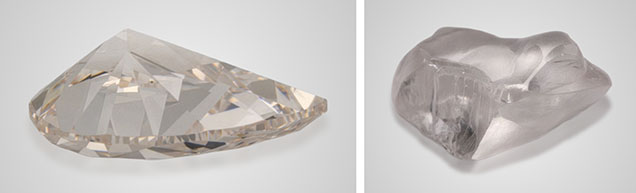
GIA’s New York laboratory received a 5.22 ct natural type IaAB pear brilliant diamond, graded as very light pinkish brown (figure 1, left). The finished diamond was matched to its previously submitted 11.07 ct rough (figure 1, right) through identical ultraviolet/visible and mid-infrared spectra.
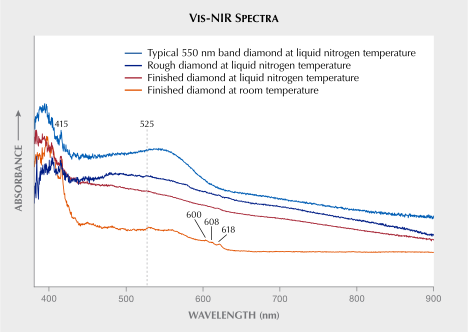
An atypical absorption band centered at 525 nm and a triplet feature at 600, 608, and 618 nm were detected in the visible/near-infrared (Vis-NIR) absorption spectrum (figure 2). These spectral features are distinct from the typical broad 550 nm absorption band associated with pink coloration from plastic deformation of the diamond structure. The N3 center (415 nm), a defect involving three nitrogen atoms and a vacancy (3N+V), was also present. Mid-infrared spectra showed a natural type IaAB diamond in the one-phonon region (~1332–400 cm–1), revealing nitrogen aggregation from prolonged residence at high mantle temperatures. The A-center (1282 cm–1) results from two adjacent substitutional nitrogen atoms (N-N), and the B-center (1175 cm–1) from four adjacent substitutional nitrogen atoms surrounding a vacancy (4N+V).
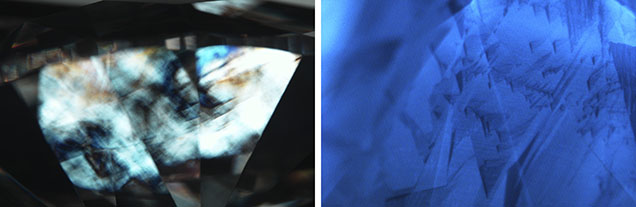
Microscopic observation revealed a cloud composed of needle-like inclusions, transparent internal graining, and color zoning caused by plastic deformation of the crystal structure. Mottled strain patterns were observed with high interference colors under cross-polarized light (figure 3, left), indicative of internal stress and crystal structure distortion during natural diamond formation. DiamondView fluorescence showed crystal growth patterns and blue emission caused by the presence of the N3 center in the crystal structure (figure 3, right). Gemological testing supported a natural diamond and natural color origin, with no evidence of surface coating, treatment, or laboratory growth.
The cause of the 525 nm absorption band and triplet feature at 600, 608, and 618 nm remains unknown. A prior study of a pink diamond with a 525 nm absorption band found high concentrations of nickel- and hydrogen-related defects (S. Caplan and W. Wang, “Natural pink diamond colored by the 525 nm absorption band,” GSA Abstracts with Programs, Vol. 54, No. 5, 2022). However, no such impurities were detected in this diamond, suggesting that the 525 nm absorption band, to the author’s knowledge, has not been previously documented. Weak 600 and 609 nm peaks appear more prominently in type IIa and low nitrogen pink diamonds colored by the 550 nm band (S. Eaton-Magaña et al., “Comparison of gemological and spectroscopic features in type IIa and Ia natural pink diamonds,” Diamond and Related Materials, Vol. 105, 2020, article no. 107784), possibly originating from unidentified point defects in the diamond structure, which differ from the spectral features seen in this diamond. The 525 nm band and triplet feature observed in this diamond are likely an atypical naturally occurring previously undocumented color center. These atypical absorption spectral features demonstrate the complexity of diamond color origin and the need for further research into natural diamond color centers.
Erica Watts is a research associate at GIA in New York.
GIA’s New York laboratory received a 5.22 ct natural type IaAB pear brilliant diamond, graded as very light pinkish brown (figure 1, left). The finished diamond was matched to its previously submitted 11.07 ct rough (figure 1, right) through identical ultraviolet/visible and mid-infrared spectra.
An atypical absorption band centered at 525 nm and a triplet feature at 600, 608, and 618 nm were detected in the visible/near-infrared (Vis-NIR) absorption spectrum (figure 2). These spectral features are distinct from the typical broad 550 nm absorption band associated with pink coloration from plastic deformation of the diamond structure. The N3 center (415 nm), a defect involving three nitrogen atoms and a vacancy (3N+V), was also present. Mid-infrared spectra showed a natural type IaAB diamond in the one-phonon region (~1332–400 cm–1), revealing nitrogen aggregation from prolonged residence at high mantle temperatures. The A-center (1282 cm–1) results from two adjacent substitutional nitrogen atoms (N-N), and the B-center (1175 cm–1) from four adjacent substitutional nitrogen atoms surrounding a vacancy (4N+V).
Microscopic observation revealed a cloud composed of needle-like inclusions, transparent internal graining, and color zoning caused by plastic deformation of the crystal structure. Mottled strain patterns were observed with high interference colors under cross-polarized light (figure 3, left), indicative of internal stress and crystal structure distortion during natural diamond formation. DiamondView fluorescence showed crystal growth patterns and blue emission caused by the presence of the N3 center in the crystal structure (figure 3, right). Gemological testing supported a natural diamond and natural color origin, with no evidence of surface coating, treatment, or laboratory growth.
The cause of the 525 nm absorption band and triplet feature at 600, 608, and 618 nm remains unknown. A prior study of a pink diamond with a 525 nm absorption band found high concentrations of nickel- and hydrogen-related defects (S. Caplan and W. Wang, “Natural pink diamond colored by the 525 nm absorption band,” GSA Abstracts with Programs, Vol. 54, No. 5, 2022). However, no such impurities were detected in this diamond, suggesting that the 525 nm absorption band, to the author’s knowledge, has not been previously documented. Weak 600 and 609 nm peaks appear more prominently in type IIa and low nitrogen pink diamonds colored by the 550 nm band (S. Eaton-Magaña et al., “Comparison of gemological and spectroscopic features in type IIa and Ia natural pink diamonds,” Diamond and Related Materials, Vol. 105, 2020, article no. 107784), possibly originating from unidentified point defects in the diamond structure, which differ from the spectral features seen in this diamond. The 525 nm band and triplet feature observed in this diamond are likely an atypical naturally occurring previously undocumented color center. These atypical absorption spectral features demonstrate the complexity of diamond color origin and the need for further research into natural diamond color centers.
Erica Watts is a research associate at GIA in New York.