
A 2.38 ct very light blue gemstone was recently submitted to GIA’s Bangkok laboratory for identification and geographic origin determination. Standard and advanced gemological testing results were consistent with a Sri Lankan sapphire that had undergone high-temperature heat treatment.
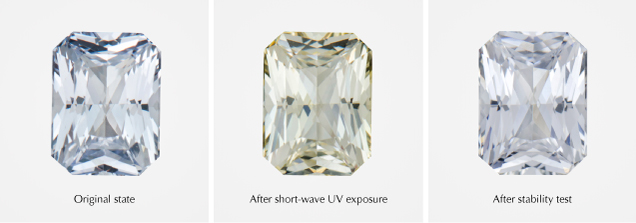
During routine gemological examination, an unexpected color change was observed. After approximately 30 to 40 seconds of exposure to short-wave (254 nm) ultraviolet radiation, the stone’s bodycolor changed from an initial very light blue to a light yellow color. Given the unusual nature of this observation, the stone was subsequently subjected to fade testing under GIA color-stability testing conditions using a 150W halogen lamp. After approximately six hours, the yellow color gradually faded, and the bodycolor returned to an appearance similar to its original very light blue coloration (figure 1), confirming that the color change was temporary and reversible.
This behavior is consistent with activation of an unstable trapped-hole color center that can exist in either an inactive (ground) state or an activated state following exposure to ultraviolet radiation (K. Nassau and G.K. Valente, “The seven types of yellow sapphire and their stability to light,” Winter 1987 G&G, pp. 222–231). In this case, short-wave UV radiation provided sufficient energy to activate the color center and produce a temporary yellow color. However, the induced color was not stable and gradually returned to its inactive state over time or under incandescent illumination. Color descriptions should be based on the color observed after color-stability testing.
Although color-stability testing is not routinely performed for sapphires in this color range, this behavior is consistent with previously documented examples of sapphires containing unstable color centers, particularly some Sri Lankan material. Similar reversible color changes have been reported in sapphires with color influenced by trapped-hole color centers, including yellow, orange, and pinkish orange to orangy pink sapphires (“An update on sapphires with unstable color,” GIA Research News, December 12, 2022).
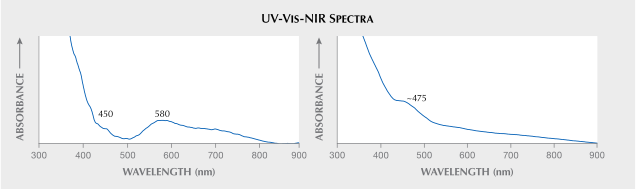
Ultraviolet/visible/near-infrared spectroscopic data support this interpretation. Before UV exposure, the stone showed spectral features typical of metamorphic blue sapphire; absorption in the 380–390 nm region (associated with Fe3+) was relatively weak, consistent with low iron content, while a distinct absorption peak at 450 nm (attributed to Fe3+-Fe3+ pair interactions) was observed, together with an Fe2+/Ti4+ intervalence charge-transfer band near 580 nm. After short-wave UV exposure, the 580 nm absorption feature was no longer resolved, and the spectrum became dominated by an absorption band centered near 475 nm, consistent with the activation of Fe3+-related trapped-hole color centers (figure 2) (E.V. Dubinsky et al., “A quantitative description of the causes of color in corundum,” Spring 2020 G&G, pp. 2–28). After fading, the spectrum returned to its original state.
Importantly, this UV-activated and reversible color change is unrelated to the stone’s high-temperature heat treatment. Previous studies have shown that heating does not stabilize color derived from unstable color centers (C.P. Smith et al., “Heated sapphires with unstable colour centres,” Journal of Gemmology, Vol. 36, No. 7, 2019, pp. 602–604). The observations in this case, therefore, are consistent with established theoretical models and previously documented examples of unstable color-center behavior in Sri Lankan corundum.
Aprisara Semapongpan is a staff gemologist at GIA in Bangkok.
A 2.38 ct very light blue gemstone was recently submitted to GIA’s Bangkok laboratory for identification and geographic origin determination. Standard and advanced gemological testing results were consistent with a Sri Lankan sapphire that had undergone high-temperature heat treatment.
During routine gemological examination, an unexpected color change was observed. After approximately 30 to 40 seconds of exposure to short-wave (254 nm) ultraviolet radiation, the stone’s bodycolor changed from an initial very light blue to a light yellow color. Given the unusual nature of this observation, the stone was subsequently subjected to fade testing under GIA color-stability testing conditions using a 150W halogen lamp. After approximately six hours, the yellow color gradually faded, and the bodycolor returned to an appearance similar to its original very light blue coloration (figure 1), confirming that the color change was temporary and reversible.
This behavior is consistent with activation of an unstable trapped-hole color center that can exist in either an inactive (ground) state or an activated state following exposure to ultraviolet radiation (K. Nassau and G.K. Valente, “The seven types of yellow sapphire and their stability to light,” Winter 1987 G&G, pp. 222–231). In this case, short-wave UV radiation provided sufficient energy to activate the color center and produce a temporary yellow color. However, the induced color was not stable and gradually returned to its inactive state over time or under incandescent illumination. Color descriptions should be based on the color observed after color-stability testing.
Although color-stability testing is not routinely performed for sapphires in this color range, this behavior is consistent with previously documented examples of sapphires containing unstable color centers, particularly some Sri Lankan material. Similar reversible color changes have been reported in sapphires with color influenced by trapped-hole color centers, including yellow, orange, and pinkish orange to orangy pink sapphires (“An update on sapphires with unstable color,” GIA Research News, December 12, 2022).
Ultraviolet/visible/near-infrared spectroscopic data support this interpretation. Before UV exposure, the stone showed spectral features typical of metamorphic blue sapphire; absorption in the 380–390 nm region (associated with Fe3+) was relatively weak, consistent with low iron content, while a distinct absorption peak at 450 nm (attributed to Fe3+-Fe3+ pair interactions) was observed, together with an Fe2+/Ti4+ intervalence charge-transfer band near 580 nm. After short-wave UV exposure, the 580 nm absorption feature was no longer resolved, and the spectrum became dominated by an absorption band centered near 475 nm, consistent with the activation of Fe3+-related trapped-hole color centers (figure 2) (E.V. Dubinsky et al., “A quantitative description of the causes of color in corundum,” Spring 2020 G&G, pp. 2–28). After fading, the spectrum returned to its original state.
Importantly, this UV-activated and reversible color change is unrelated to the stone’s high-temperature heat treatment. Previous studies have shown that heating does not stabilize color derived from unstable color centers (C.P. Smith et al., “Heated sapphires with unstable colour centres,” Journal of Gemmology, Vol. 36, No. 7, 2019, pp. 602–604). The observations in this case, therefore, are consistent with established theoretical models and previously documented examples of unstable color-center behavior in Sri Lankan corundum.
Aprisara Semapongpan is a staff gemologist at GIA in Bangkok.