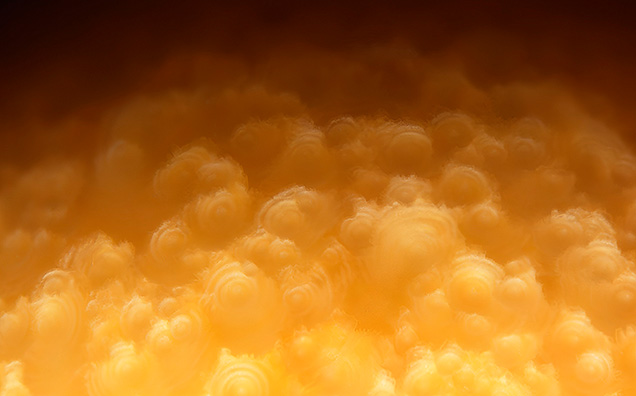
Spiral patterns are frequently observed in nature, such as those in fingerprints, plant stems, shells, or even faraway galaxies. Recently, a collection of 35 pearls arranged in a necklace layout was submitted to GIA’s Bangkok laboratory (Spring 2025 Lab Notes, pp. 66–68). This submission included a 6.79 ct orange round non-nacreous pearl that possessed an enchanting spiral surface structure. The pearl exhibited a noticeable patchy series of circular features covering the entire surface. Under 30× magnification, the circular features appeared scale-like, with a spiral pattern within each “scale” and short flames on the rims (see above). The pearl displayed no evidence of a worked surface, only some fine visible scratches, suggesting the spiral structure was original to the pearl and not caused by any surface treatment.
Real-time X-ray microradiography, energy-dispersive X-ray fluorescence, and Raman spectroscopy indicated the pearl was of saltwater origin and natural color. Its high porcelain-like luster, spiky short flames, and orange bodycolor resembled some Melo (Melo species) and horse conch (Fasciolariinae subfamily) pearls. However, the spiral structure is rarely observed and has only been encountered in a few non-nacreous pearls previously studied by GIA. Therefore, the mollusk species that formed this pearl is currently undeterminable, and further study is required for precise mollusk determination. While the exact species that produced this special pearl remains inconclusive, its fascinating spiral pattern is undoubtedly worthy of note.
Spiral patterns are frequently observed in nature, such as those in fingerprints, plant stems, shells, or even faraway galaxies. Recently, a collection of 35 pearls arranged in a necklace layout was submitted to GIA’s Bangkok laboratory (Spring 2025 Lab Notes, pp. 66–68). This submission included a 6.79 ct orange round non-nacreous pearl that possessed an enchanting spiral surface structure. The pearl exhibited a noticeable patchy series of circular features covering the entire surface. Under 30× magnification, the circular features appeared scale-like, with a spiral pattern within each “scale” and short flames on the rims (see above). The pearl displayed no evidence of a worked surface, only some fine visible scratches, suggesting the spiral structure was original to the pearl and not caused by any surface treatment.
Real-time X-ray microradiography, energy-dispersive X-ray fluorescence, and Raman spectroscopy indicated the pearl was of saltwater origin and natural color. Its high porcelain-like luster, spiky short flames, and orange bodycolor resembled some Melo (Melo species) and horse conch (Fasciolariinae subfamily) pearls. However, the spiral structure is rarely observed and has only been encountered in a few non-nacreous pearls previously studied by GIA. Therefore, the mollusk species that formed this pearl is currently undeterminable, and further study is required for precise mollusk determination. While the exact species that produced this special pearl remains inconclusive, its fascinating spiral pattern is undoubtedly worthy of note.
.jpg "YMAL GIA Ed")