
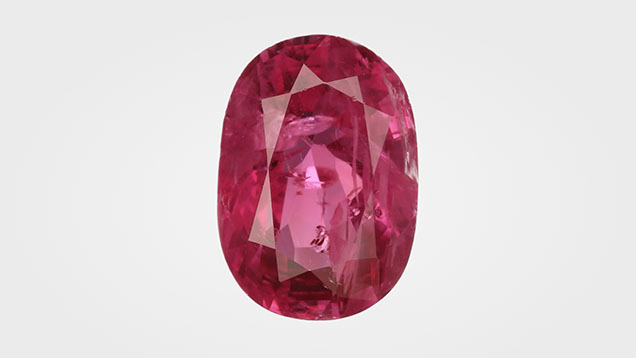
The Hong Kong laboratory recently received a 3.37 ct transparent purplish red oval mixed cut for identification (figure 1). Although the stone was submitted as a ruby, subsequent testing suggested a different identity. Standard gemological testing revealed a single refractive index (RI) of 1.717, consistent with spinel rather than doubly refractive ruby (1.760–1.768). Additionally, ruby and red spinel exhibit distinct absorption spectra. Ruby is characterized by a bright chromium fluorescent emission line at 693 nm, along with two fine dark lines in the blue portion of the spectrum at 468 nm and 476 nm. In the blue region where ruby shows distinct doublet lines, spinel typically shows a broad, featureless absorption band and lacks the sharp 476 nm line.
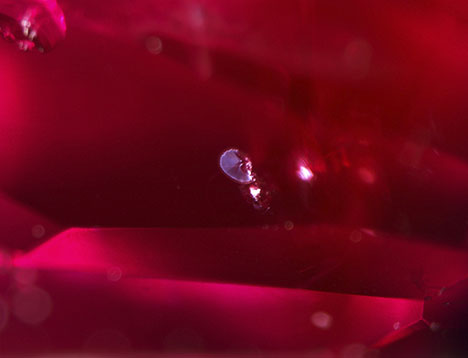
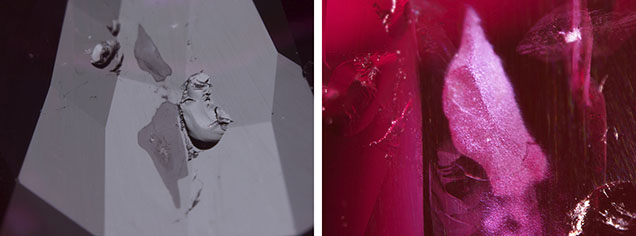
Microscopic examination revealed several features: altered crystal inclusions with discoidal fractures (figure 2), whitish healed fissures, and the presence of exogenous materials within surface-reaching fractures and cavities. Based on the combination of RI, specific gravity, absorption spectrum, and observed natural inclusion features, as well as laser ablation–inductively coupled plasma–mass spectrometry chemistry, the stone was identified as a natural spinel. Additionally, certain cavities displayed a granular texture with lower luster, indicative of filler material, suggesting artificial treatment (figure 3).
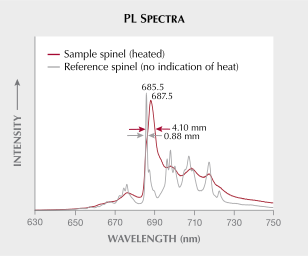
Heat treatment of spinel is considerably less common than that of ruby; however, heat-treated spinel does exist in the marketplace. For spinel specimens with exceptional clarity, microscopic examination alone is generally insufficient to detect evidence of heating. All spinel samples submitted to GIA are analyzed using photoluminescence (PL) spectroscopy as a primary method for evaluating potential heat treatment. The spectrum of the unheated reference spinel shows the peak with the highest counts positioned at 685.5 nm, with a full width at half maximum (FWHM) of 0.88 nm (figure 4). In contrast, the sample spectrum exhibits a peak shifted to 687.5 nm, with a significantly broader FWHM of 4.10 nm. This peak broadening and wavelength shift are consistent with characteristics typically observed in heated spinel spectra (S. Saeseaw et al., “Distinguishing heated spinels from unheated natural spinels and from synthetic spinels,” GIA Research News, April 2, 2009). Raman spectroscopic analysis further characterized the studied stone’s filler as glass.
Historical evidence demonstrates that reliance on stone color alone can result in misclassification, underscoring the necessity of comprehensive analytical approaches for accurate gemstone identification. Red spinel has been the ultimate “imposter,” famously misidentified as ruby for centuries. The most notable example is the Black Prince’s Ruby set in the British Imperial State Crown.
The submitted spinel appears to have undergone unusually aggressive heating, possibly because it was misidentified as ruby prior to treatment. Such a scenario in the studied sample could explain the presence of glassy surface material and severely damaged inclusions, features atypical of heated spinel. While speculative, this possibility highlights the importance of accurate identification before treatment and the role of advanced spectroscopic methods in detecting such interventions.
Tsz Wing Lai is an advanced staff gemologist at GIA in Hong Kong. Amy Cooper is manager of colored stone identification at GIA in Carlsbad.
The Hong Kong laboratory recently received a 3.37 ct transparent purplish red oval mixed cut for identification (figure 1). Although the stone was submitted as a ruby, subsequent testing suggested a different identity. Standard gemological testing revealed a single refractive index (RI) of 1.717, consistent with spinel rather than doubly refractive ruby (1.760–1.768). Additionally, ruby and red spinel exhibit distinct absorption spectra. Ruby is characterized by a bright chromium fluorescent emission line at 693 nm, along with two fine dark lines in the blue portion of the spectrum at 468 nm and 476 nm. In the blue region where ruby shows distinct doublet lines, spinel typically shows a broad, featureless absorption band and lacks the sharp 476 nm line.
Microscopic examination revealed several features: altered crystal inclusions with discoidal fractures (figure 2), whitish healed fissures, and the presence of exogenous materials within surface-reaching fractures and cavities. Based on the combination of RI, specific gravity, absorption spectrum, and observed natural inclusion features, as well as laser ablation–inductively coupled plasma–mass spectrometry chemistry, the stone was identified as a natural spinel. Additionally, certain cavities displayed a granular texture with lower luster, indicative of filler material, suggesting artificial treatment (figure 3).
Heat treatment of spinel is considerably less common than that of ruby; however, heat-treated spinel does exist in the marketplace. For spinel specimens with exceptional clarity, microscopic examination alone is generally insufficient to detect evidence of heating. All spinel samples submitted to GIA are analyzed using photoluminescence (PL) spectroscopy as a primary method for evaluating potential heat treatment. The spectrum of the unheated reference spinel shows the peak with the highest counts positioned at 685.5 nm, with a full width at half maximum (FWHM) of 0.88 nm (figure 4). In contrast, the sample spectrum exhibits a peak shifted to 687.5 nm, with a significantly broader FWHM of 4.10 nm. This peak broadening and wavelength shift are consistent with characteristics typically observed in heated spinel spectra (S. Saeseaw et al., “Distinguishing heated spinels from unheated natural spinels and from synthetic spinels,” GIA Research News, April 2, 2009). Raman spectroscopic analysis further characterized the studied stone’s filler as glass.
Historical evidence demonstrates that reliance on stone color alone can result in misclassification, underscoring the necessity of comprehensive analytical approaches for accurate gemstone identification. Red spinel has been the ultimate “imposter,” famously misidentified as ruby for centuries. The most notable example is the Black Prince’s Ruby set in the British Imperial State Crown.
The submitted spinel appears to have undergone unusually aggressive heating, possibly because it was misidentified as ruby prior to treatment. Such a scenario in the studied sample could explain the presence of glassy surface material and severely damaged inclusions, features atypical of heated spinel. While speculative, this possibility highlights the importance of accurate identification before treatment and the role of advanced spectroscopic methods in detecting such interventions.
Tsz Wing Lai is an advanced staff gemologist at GIA in Hong Kong. Amy Cooper is manager of colored stone identification at GIA in Carlsbad.